
Reviewed · FISHERMAN'S BASTION TOURS
Buda Castle Tour: Fisherman’s bastion and hidden gems
Fisherman’s Bastion may be the postcard view, but the pleasure of this two-hour Castle District walk is seeing how much history gathers around it: a medieval church, a plague monument, a pastry shop dating to 1827, and Hungary’s presidential residence. The route ends at Buda Castle, with sweeping views and plenty of stories along the way.
I like that the walk balances famous sights with smaller stops, including Ruszwurm Confectionery and the Hadik statue, and that the group is capped at 10 people. Guides such as Sou, Bayler, Nacho, Ignacio, and Sophie have been praised for making the history lively and for offering useful local recommendations.
The main consideration is the terrain. Castle Hill has hills and steps, and the full route may feel harder in scorching heat or heavy rain. You also see Matthias Church from outside, and the tour passes the Hospital in the Rock and the labyrinth without entering either.
What to know before you go
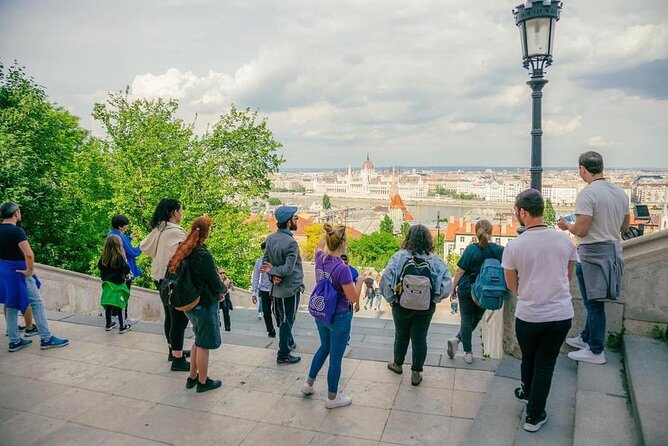
- Fisherman’s Bastion is the visual highlight: Its turrets, arches, and terraces frame broad views over the Danube and Budapest.
- The walk includes more than the headline sights: You pass historic squares, a long-running confectionery, royal buildings, and a famous bronze horse.
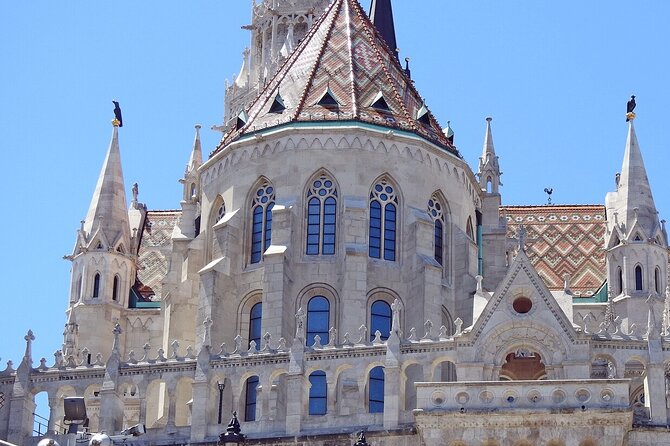
- Matthias Church is an exterior stop: The church’s tile roof and Gothic Revival details are part of the visit, but entry is not included.
- Expect a small group: The maximum is 10, which can make it easier to hear the guide and ask questions.
- The price is unusually low: At $3.63 per person, the tour offers a guided overview, but it does not include tips or entry to the church.
- Weather and stamina matter: The route covers a hilly district, so comfortable walking shoes and a sensible pace will help.
Start at Trinity Square
The meeting point is Szentháromság tér, in the Castle District. From there, the route begins among some of Buda’s most recognizable sights, with the guide providing context that can be hard to piece together on your own when several centuries of architecture sit side by side.
The tour is listed at about two hours, with short stops at each landmark. That format suits you if you want an organized introduction to the district rather than a long museum visit. You’ll have time to look, take photos, and hear the story, but not to linger at every stop.
The group limit of 10 is a practical plus. On a walking tour, a small group tends to make it easier to keep together and follow the guide’s explanations. It also gives you a better chance to ask questions about places that catch your attention.
More Fisherman's Bastion tours in Budapest:
- Walking tour in the Buda Castle incl. Fisherman’s Bastion
★ 5.0 · 467 reviews - Private photography photo session at Fisherman Bastion
★ 5.0 · 269 reviews - Buda Castle Walking Tour: Fishermans Bastion – Royal Palace
★ 4.9 · 128 reviews
Matthias Church from the outside
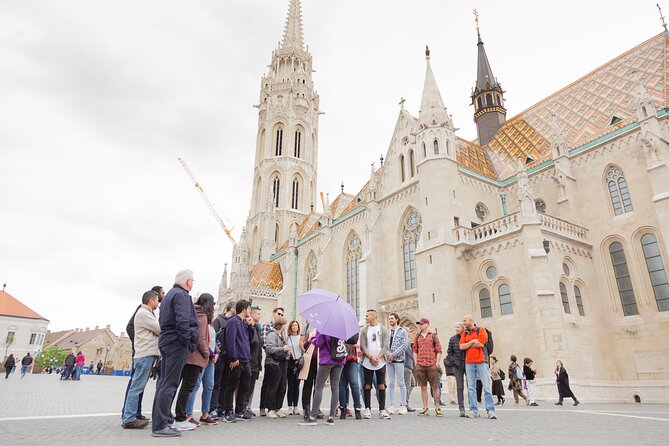
The first named stop is Matthias Church, a landmark with more than 700 years of history. The church is known for its Gothic Revival design, intricate spires, colorful tiled roof, and interior frescoes. This tour takes photos outside and does not include admission, so think of the stop as an introduction to the building rather than a church visit.
That distinction matters if seeing the interior is high on your list. You can admire the exterior with the guide, hear the church’s royal stories, and note the details before deciding whether to return on your own. The stop is planned for 15 minutes, which is enough for a look and some photos, but not a deep exploration.
The views at Fisherman’s Bastion
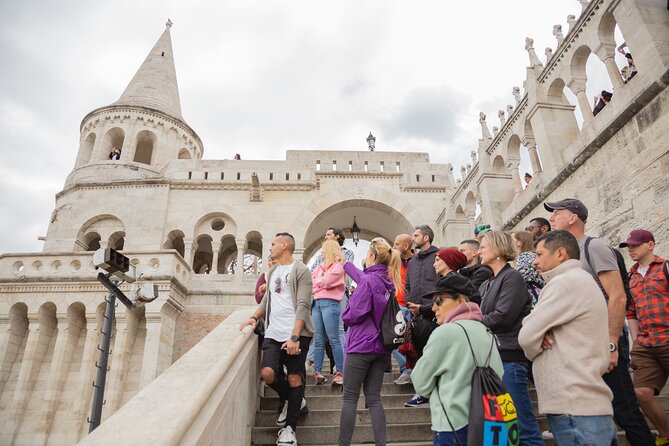
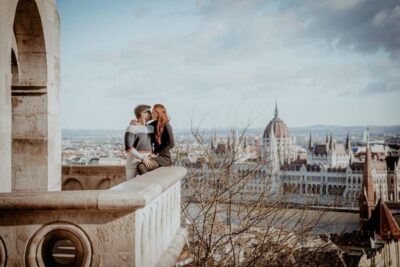
Fisherman’s Bastion gets another 15 minutes. This terrace is built in a neo-Gothic and neo-Romanesque style, with turrets, arches, and pathways that give it a storybook appearance. The bigger draw is the view across the Danube and the Budapest skyline.
I’d treat this as a key photo stop, but not only a photo stop. The elevated outlook helps you understand the city’s layout and the relationship between the Castle District and the river below. The admission is listed as free, so there is no ticket charge for this stop.
Trinity Square and its monuments
The route pauses at the Holy Trinity Column, a carved monument commemorating the end of an 18th-century plague. It takes about five minutes, a brief stop that makes more sense once the guide explains why the column was erected and what it represents.
There is also a stop by an iconic building near Holy Trinity Square. The information provided does not name the building, so the guide’s explanation will be the useful part here. This area is a good reminder that the Castle District is not just a string of scenic viewpoints. Its public spaces also record the city’s religious and political past.
More Buda Castle tours in Budapest:
- Budapest: Buda Castle Cave Tour
★ 4.7 · 5,677 reviews - Budapest: Buda Castle District Vampires and Myths Night Tour
★ 4.6 · 3,830 reviews - Budapest: Buda Castle Walk with Saint Stephen’s Hall
★ 4.5 · 3,012 reviews - Budapest: Buda Castle District Walking Tour
★ 4.6 · 2,108 reviews
A sweet stop at Ruszwurm
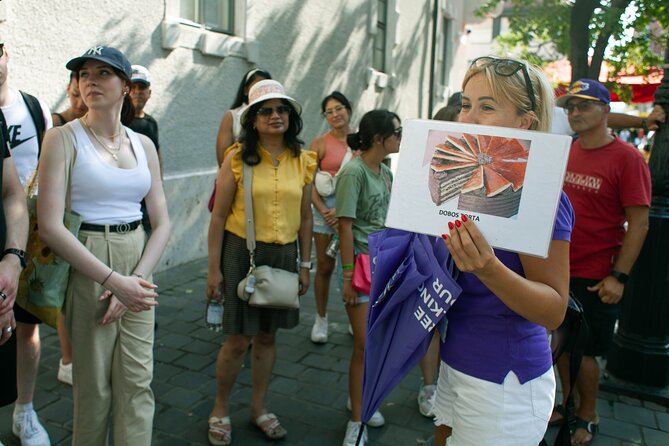
Ruszwurm Confectionery has been serving cakes since 1827. The tour allows about 10 minutes here, introducing you to a traditional pastry shop where you may see Hungarian favorites such as Dobos torta and krémes.
The stop is described as a chance to savor the shop’s atmosphere and handmade desserts, but no purchase is included in the tour price. Ten minutes is short if you want to sit down and enjoy a cake at leisure. If you are keen to linger, ask the guide for a recommendation and consider returning after the walk.
This is one of the route’s more human-scale moments. A historic church and a royal palace can feel grand and distant; a neighborhood confectionery gives you a more everyday connection to the district.
Hadik’s horse and a quieter residential stretch
At the statue of mounted András Hadik, the guide shares the story of a celebrated Hungarian soldier and Maria Theresa’s favorite general. Hadik was known for daring victories, and the bronze horse has a playful local tradition: touching its shiny part is said to bring good luck. You’ll see the spot for yourself.
The stop lasts about five minutes, so this is a quick tale rather than a full lesson in military history. Still, it adds a bit of humor to a route otherwise full of churches, palaces, and formal monuments.
Next comes the Árpád Tóth Promenade, a residential part of Castle Hill. The walk gives you a glimpse beyond the major landmarks, with about 10 minutes set aside for this stretch. The Hospital in the Rock is also discussed as you pass by. The museum offers private guided tours in English, but this walk does not enter it.
The labyrinth is another point of interest along the way. It is described as a pass-by, not an included visit, so don’t plan on exploring it underground during this tour. If either the hospital museum or labyrinth is a priority, treat the walk as an introduction and arrange a separate visit.
Presidential buildings and the old Riding Hall
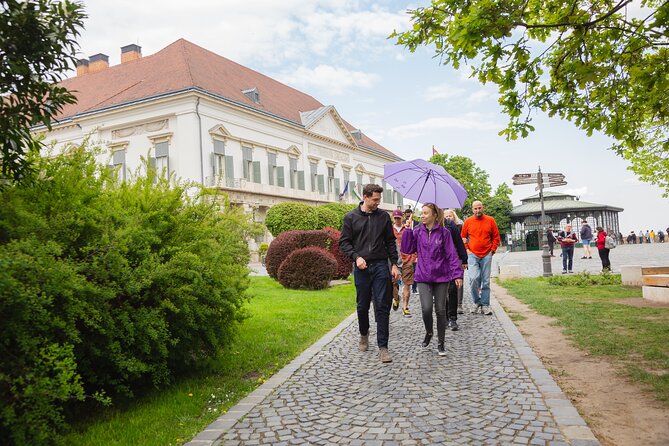
The route continues to Sándor Palace, the official residence of Hungary’s president. It takes about five minutes. The palace is named for its original owner, Count Sándor Móricz, a horseman famous for daring stunts and nicknamed the Devil’s Rider. That detail offers a livelier angle on a building that might otherwise seem purely official.
Nearby, the former Carmelite Monastery has had several roles. It began as a monastery, later served as a theater and concert hall, and now houses the Hungarian Prime Minister’s Office. The tour allows about 10 minutes at this stop, an opportunity to trace how the same building has adapted to different eras and uses.
You also pass the Buda Hill Funicular, which has operated since 1870 and links the Chain Bridge with the Castle District. The stop is listed at 10 minutes, and the ride is known for views of the Danube and city. The tour description does not say that a ride is included, so don’t assume the walk’s price covers a ticket.
The restored Riding Hall is another brief stop, about five minutes. It once served as a royal equestrian facility. Together, these locations show the district’s changing purpose: religious center, cultural venue, royal setting, and government quarter.
Matthias Fountain and the palace precinct
Matthias Fountain is a Baroque-style monument dedicated to King Matthias Corvinus. Its central figure shows the king on horseback, linking the fountain to the power and cultural life of his 15th-century reign. The planned stop is about 10 minutes, giving you time to take in the sculpture and hear the story behind it.
The walk then reaches Buda Castle, the former Royal Palace and the tour’s endpoint at Szent György tér, by the entrance of the National Gallery. The palace complex is home to the Hungarian National Gallery, the Budapest History Museum, and the National Library. Entry to these institutions is not listed as part of the walk, so plan extra time and separate admission if you want to explore inside.
The final stop is scheduled for about 15 minutes. That gives the guide room to explain the palace and orient you to the museums, but it is not a substitute for a museum visit. The end point is useful: you can finish with a clear sense of where the main cultural institutions are and choose what to see next.
What the price does, and does not, buy
At $3.63 per person, this is an inexpensive way to get a guided overview of Castle Hill. The fee includes professional guides and tailor-made recommendations for restaurants, bars, and museums. Tips are not included, and the tour does not cover admission to Matthias Church or the Hospital in the Rock. The labyrinth is also only passed by.
That low price makes most sense if you want orientation, stories, and a route linking the district’s main sights. It is less suitable if you expect entry to paid attractions, a long stop for cake, or extensive time at each monument. The value is in having a guide connect the places and share context, not in bundled tickets.
The tour is offered in English and uses a mobile ticket. It is near public transportation, and most people can participate, but the walk’s hills and steps are worth taking seriously. One person found the climb manageable while noting the effort involved; another could not finish the full route in very hot weather. Heavy rain can also change the feel of the outing, so dress for the forecast and be realistic about your stamina.
The guide can make the history click
The guide is central to this experience. Sou has been praised for involving the group and sharing lesser-known information. Bayler kept the tour engaging through torrential rain, while Nacho and Ignacio were noted for warmth, humor, and practical local suggestions. Sophie has also led the walk with an engaging style and plenty of information about Castle Hill.
Those names are useful examples, not a promise of who will lead your departure. What you can reasonably expect is an English-speaking professional guide, with a small group and a route built around stories as well as landmarks. The strongest reason to book is the human explanation: it can turn a sequence of handsome buildings into a story you can follow.
Who should book this walk?
Book it if you want a compact introduction to Buda Castle Hill, value local context, and are comfortable walking uphill. It suits first-time visitors who want to see Fisherman’s Bastion and Matthias Church while also learning about the surrounding monuments and government buildings.
It is also a sensible choice if you want recommendations for what to do after the tour. The guide can point you toward restaurants, bars, and museums, and the endpoint puts you near the National Gallery and other palace institutions.
Skip it, or choose a slower alternative, if you need step-free access, want to enter every attraction, or prefer to spend a long time at each stop. The route is full of quick visits, and the heat or rain can make the hills feel more demanding. For a short, low-cost overview with a good mix of views and history, it is a strong fit.
FAQ
How long does the tour take?
The tour lasts about two hours. Stops are generally brief, ranging from about five to 15 minutes.
Where does the tour start and end?
It starts at Szentháromság tér in Budapest’s Castle District and ends at Buda Castle, at Szent György tér by the entrance of the National Gallery.
What language is the tour offered in?
The tour is offered in English.
Is admission to Matthias Church included?
No. The group takes photos outside the church, and admission is not included.
Does the tour enter the Hospital in the Rock or the labyrinth?
No. The guide discusses the Hospital in the Rock and passes by it. The labyrinth is also a pass-by stop, not an included visit.
How large is the group?
The tour has a maximum of 10 participants.
What is included in the price?
The price includes professional guides and tailor-made recommendations for restaurants, bars, and museums. Tips are not included, and admission to Matthias Church is not included.
Fresh additions in Budapest
- Best of Budapest Tour★ 5.0 · 7 reviews
- Be a movie star! Film Tour, Escape room, in Budapest and Etyek★ 5.0 · 3 reviews
- Shooting package 70★ 5.0 · 14 reviews
- Best Historical Sights of Budapest Tour★ 5.0 · 7 reviews
- Capital Budapest – Half Day Private Tour (4hr)★ 5.0 · 7 reviews
- BUSÓJÁRÁS Unesco Heritage Folklore Carnival in Mohács★ 5.0 · 4 reviews
- Budapest 4 Hour Tour with a Local: Private & Custom, See the City Unscripted★ 4.0 · 7 reviews
- Analog Photo Trip★ 5.0 · 5 reviews
Fisherman's Bastion Tours, compared.

Walking tour in the Buda Castle incl. Fisherman’s Bastion
Read our review →
Private photography photo session at Fisherman Bastion
Read our review →
Buda Castle Walking Tour: Fishermans Bastion – Royal Palace
Read our review →
E-Scooter Top Sights Tour with Fisherman’s Bastion
Read our review →
Evening Castle Hill Tour with Fishermen’s Bastion
Read our review →
Browse the lists this tour appears in